
Pushback (Towbarless)
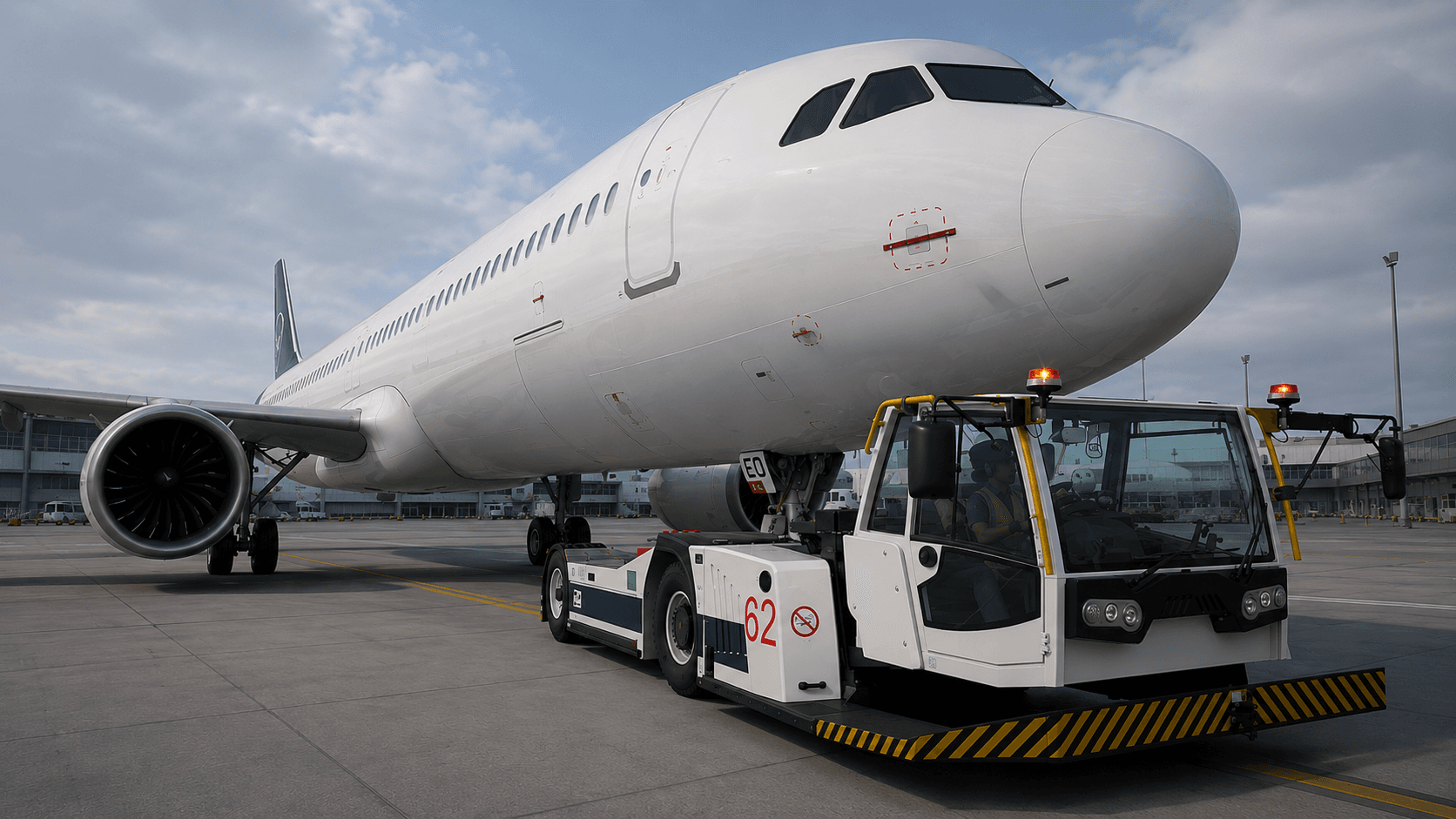
Towbarless pushback training in Virtual Reality. Based on IATA AHM and IGOM RMP12. Covers tug approach, nose gear cradle engagement, pushback execution, and aircraft release.
What You Will Train
The full towbarless pushback workflow, from approach checks through to aircraft release.
Approach & Pre-Connection Checks
PPE check, FOD inspection, and equipment external state. Brake check at 15 metres on entering the controlled approach zone, second brake check at 5 metres, and a maximum approach speed of 5 km/h. Final positioning is aligned with the nose gear axis.
Nose Gear Cradle Engagement
Steering bypass pin verification, nose wheel capture into the cradle, locking gate closure, and cradle lift to free position. Confirmation of secure engagement before the aircraft moves.
Pushback Execution & Steering
Coordinate parking brake release with the cockpit, request pushback clearance, raise the cradle, and execute the maneuver. Direct steering through the nose gear, maximum 5 km/h on turns.
Disconnect & Aircraft Release
Lower the cradle, release the locking gate, withdraw the bypass pin, and clear the aircraft area in straight reverse. Final position confirmation and clearance for taxi.
How This Differs From Towbar Pushback
Towbarless operations require different skills. The tug-aircraft connection, the steering mechanics, and the operational workflow are all distinct.
Direct Nose Gear Steering
No towbar pivot. The tug controls the aircraft directly through the cradle, which changes how turns are initiated and how the aircraft responds to steering input.
Cradle vs. Coupling
Mechanical capture of the nose wheel rather than manual coupling. Different pre-checks, different failure modes, different verification steps.
Single-Operator Workflow
Many towbarless operations run with one operator. The pushback driver manages the full sequence without a separate headset operator on the ramp.
Higher Speeds, Longer Distances
Towbarless tugs handle both pushback and longer-distance maintenance towing. Different speed regimes require different judgment and braking technique.
Cab-Forward Visibility
Dual-control or dual-facing cabs change how the operator sees the aircraft and surrounding traffic compared to a conventional pushback tractor.
Distinct Error Scenarios
Misalignment during cradle docking, oversteer warnings, and emergency abort procedures that don't exist in towbar-based pushback.
Get Notified When This Launches
Pushback (Towbarless) is currently in development. Leave your details and we will let you know when it becomes available, and which aircraft types we are prioritizing.
Towbarless Pushback in Context
For ground handlers evaluating training options, it is worth setting out where towbarless pushback sits within the broader RMP12 procedure landscape, and why the operational characteristics of the equipment shape the training it requires.
Under IATA AHM and IGOM, RMP12 Ramp Services-Aircraft Pushback covers all pushback methods, with dedicated topics for conventional towbar tractors, towbarless tractors, main gear tractors, and remote-controlled NLG pushback. Towbarless tugs sit alongside conventional tractors as a primary pushback method at most major hubs. The same regulatory framework applies (pre-pushback checks, steering bypass system handling, irregular conditions and emergencies), but the equipment characteristics and crew setup are materially different.
In day-to-day operations, towbarless tugs are typically deployed where their docking-without-lift capability, single-operator workflow, and higher-speed inter-gate towing capacity make them more efficient than towbar-based alternatives. Common models in service include the Kalmar TBL-50, TBL-190, and TBL-280 Tugmaster, the TLD TPX-200, Goldhofer AST, MotoTok, and electric variants such as the Kalmar TBL-50E and TBL-190E. Aircraft handled range from regional jets through to wide-body types, depending on the tug's nose-wheel weight rating and cradle dimensions.
The operational shifts that matter most for training are these: connection becomes a mechanical capture rather than a manual coupling, steering is direct rather than mediated through a towbar pivot, the crew configuration often drops from two-person to one-person, and braking and tractive-effort dynamics differ because the tug's design keeps these forces below conventional towbar shear-pin values. Each of these has direct implications for the procedural drills, error scenarios, and assessment criteria a training programme should cover.
Good to know
When will the Pushback (Towbarless) training be available?
We are currently in development. Leave your email in the form above and we will let you know as soon as it becomes available.
Which aircraft types will be covered?
Initial release will cover the Airbus A320 family. Additional aircraft types (including A330, B737, and B777) will follow based on customer demand. Use the form above to let us know which type matters most to you.
How does this differ from the existing Pushback (Towbar) training?
Towbar pushback uses a rigid bar between tractor and aircraft, with indirect steering. Towbarless tugs cradle the nose wheel and steer the aircraft directly through the nose gear. The equipment, the connection mechanics, the driving dynamics, and the typical crew setup are all different. Each requires dedicated training.
Is this training aligned with IATA standards?
Yes. The training content is based on IATA AHM and IGOM standards under RMP12 Ramp Services-Aircraft Pushback. The procedural sequences and safety-critical checks reflect the official syllabus.
Can this be used for both initial and recurrent training?
Yes. The module is designed for initial qualification of new operators as well as recurrent refresher training for experienced personnel, the same approach as our existing towbar pushback training.
Why use VR training for towbarless pushback?
Towbarless tugs are expensive, high-value equipment operating in close proximity to aircraft. VR training lets operators practice the full approach, cradle engagement, pushback, and disconnect sequence without risk to aircraft or equipment. Trainees can repeat procedures, experience error scenarios safely, and receive standardized assessment, without scheduling tugs or blocking gates.